3 days of thinking. 6 hours of building.
I designed and built the complete Aannapurnaa Aai Foundation website pro bono in 5 days — 45+ pages including 12 service pages and 30+ pillar-cluster articles wired to DataForSEO. Strategy, design, code, and content. Solo, with Claude Code.
ROLE
Designer · Developer · Strategist
TIMELINE
5 days
TEAM
Solo — Janam + Claude Code
SCOPE
Strategy, Web Design, Development, SEO
Aannapurnaa Aai is an elder-care facility in Borivali West, Mumbai — run by a close friend. It serves elderly people dealing with Alzheimer's, dementia, Parkinson's, paralysis, and stroke recovery — conditions requiring full-time care. The facility caps at 18 residents: not a limitation, a philosophy — stay small, care deeply.
I designed and built the complete website pro bono — strategy, information architecture, visual system, copy, code, content, and SEO. 45+ pages, including 12 service pages and 30+ pillar-cluster blog articles wired to DataForSEO. One person doing the work of a strategist, designer, frontend engineer, and content team, with Claude Code as the execution multiplier.
Pro bono, at commercial standard.The client's budget didn't determine the quality of the thinking — the comparable agency quote was ₹1.5 lakh and six weeks.
The brief said “fix the website.” The real problem was positioning and discoverability.
What existed
What was missing
A ₹30,000 agency template.
A digital presence that matched the care.
Generic stock layout, no SEO, no CMS access, no domain control.
A well-run facility with a real differentiator was invisible to the families who needed it.
Zero inbound inquiries from digital.
A way for frightened adult children to find it at the moment they search.
I audited 14 Borivali elder-care sites. 90% were broken templates or generic stock; the one or two that ranked still felt institutional — clinical, dated, cold. The design-quality bar in the local market was completely undefended.
14 SITES AUDITED · ● BROKEN / STOCK (90%) · ● RANKS BUT INSTITUTIONAL (2)
The 18-resident cap wasn't a weakness. It was the product.
The obvious read was scale: a small home with 18 beds can't compete with multi-building campuses on amenities, budget, or capacity — so compete on price or polish. That's the trap. Four hours of discovery with the founder reframed it.
What everyone assumed
What 4 hours of discovery revealed
A 18-bed home can't compete with campuses on scale, amenities, or budget.
Adult children placing a parent don't want a campus — they want a home. Deliberate smallness IS personalised care no large competitor can replicate. The cap is the moat.
The deeper insight was the actual user. The person choosing isn't the resident — it's an adult child, 40–65, making one of the most emotionally charged decisions of their life in a moment of acute concern. They aren't browsing; they're frightened. The site's job is to reduce that anxiety fast enough that they pick up the phone. Positioning followed from one sentence — “A home, not a facility” — and everything downstream fell out of it: visual direction, photography brief, content tone, the hierarchy of trust signals.
A home, not a facility — rendered across 45+ pages.
One positioning idea carried across every surface: warm photography over claims, real names and faces, dense trust signals, identical templates so 45+ pages feel like one product.
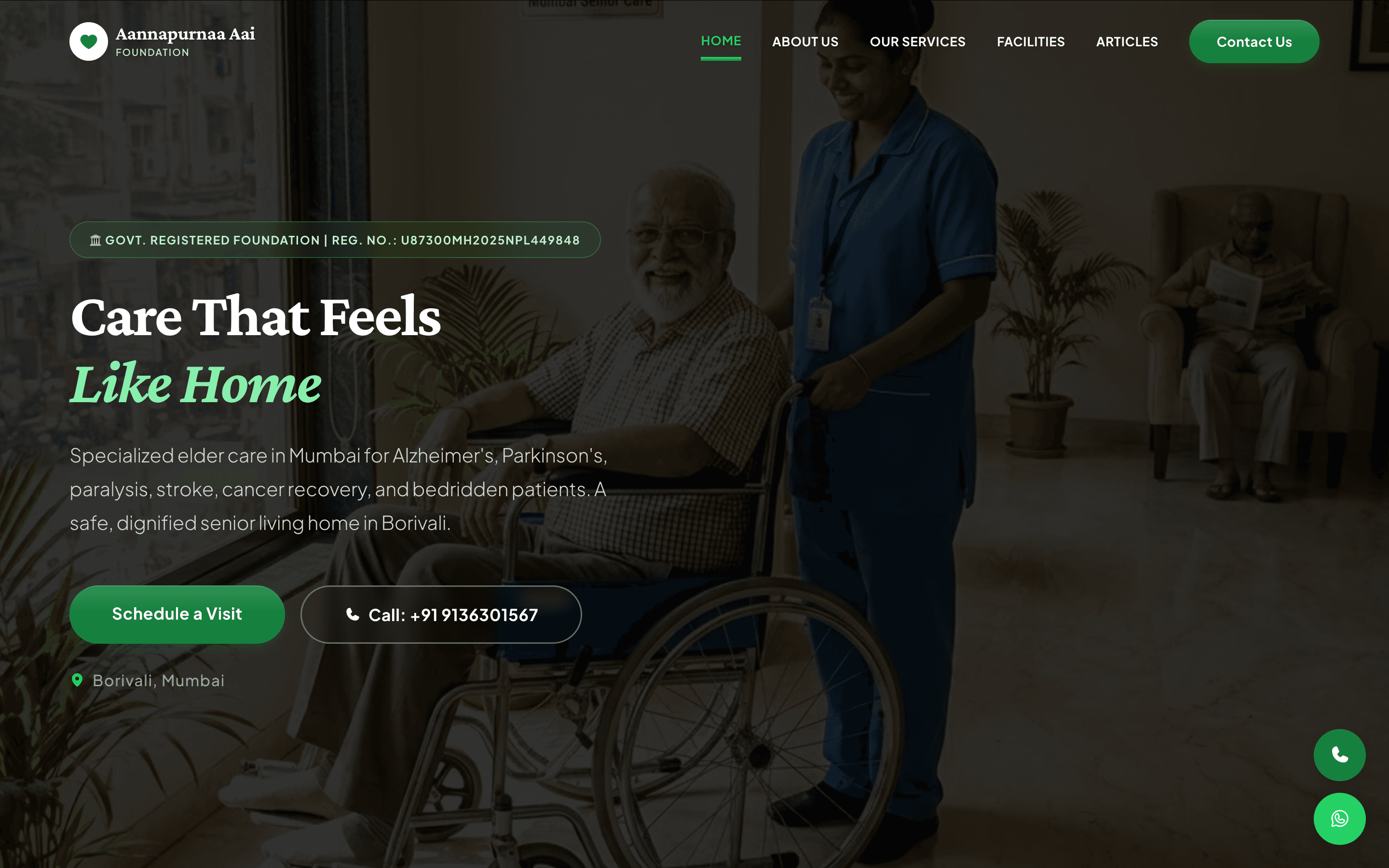
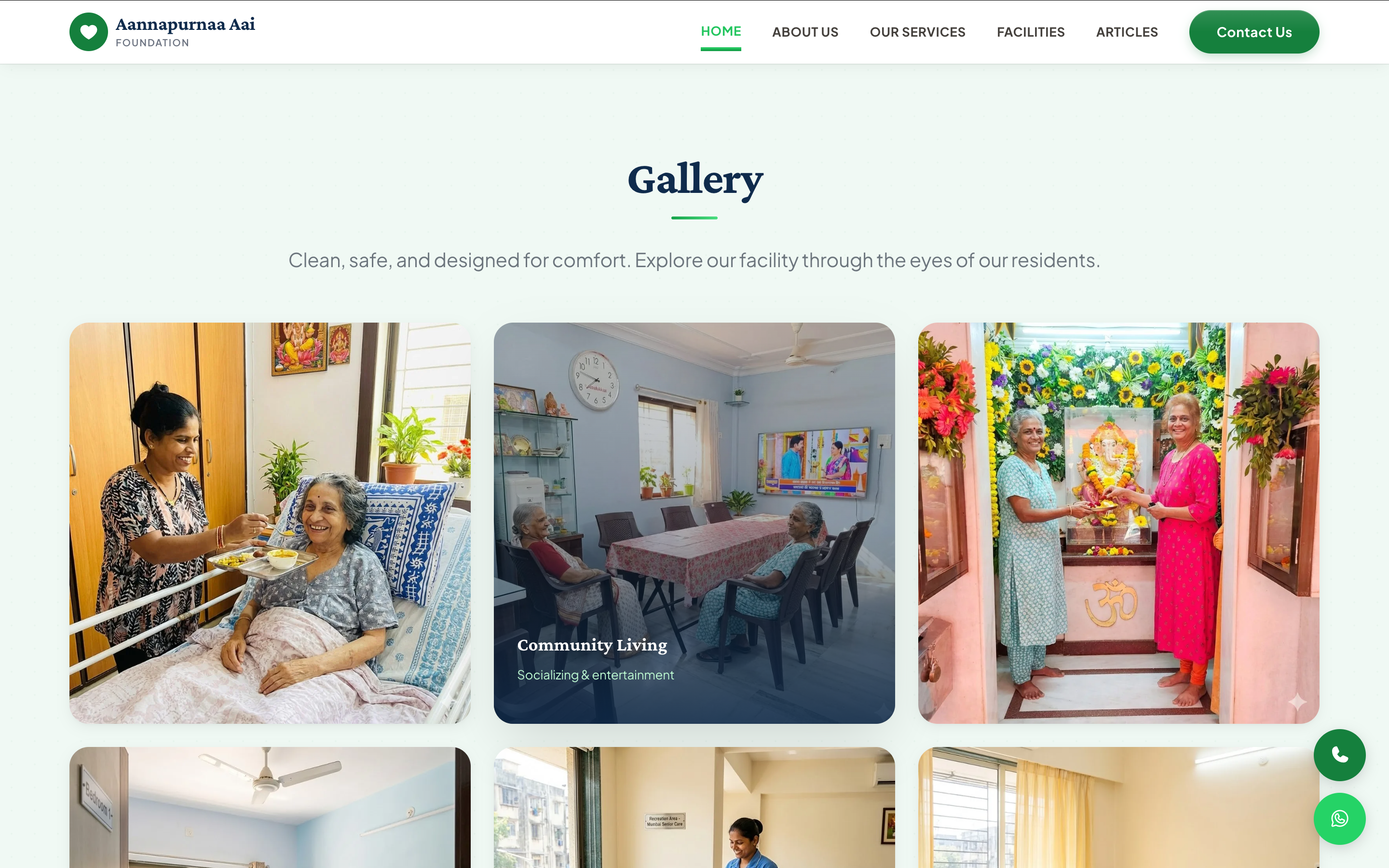
Homepage — trust signals first.
Govt-registration line up top, real photography (not stock), two-tap CTAs (Schedule a Visit / Call). The photography brief was given to the founder so every image was a real moment, not a stock library.
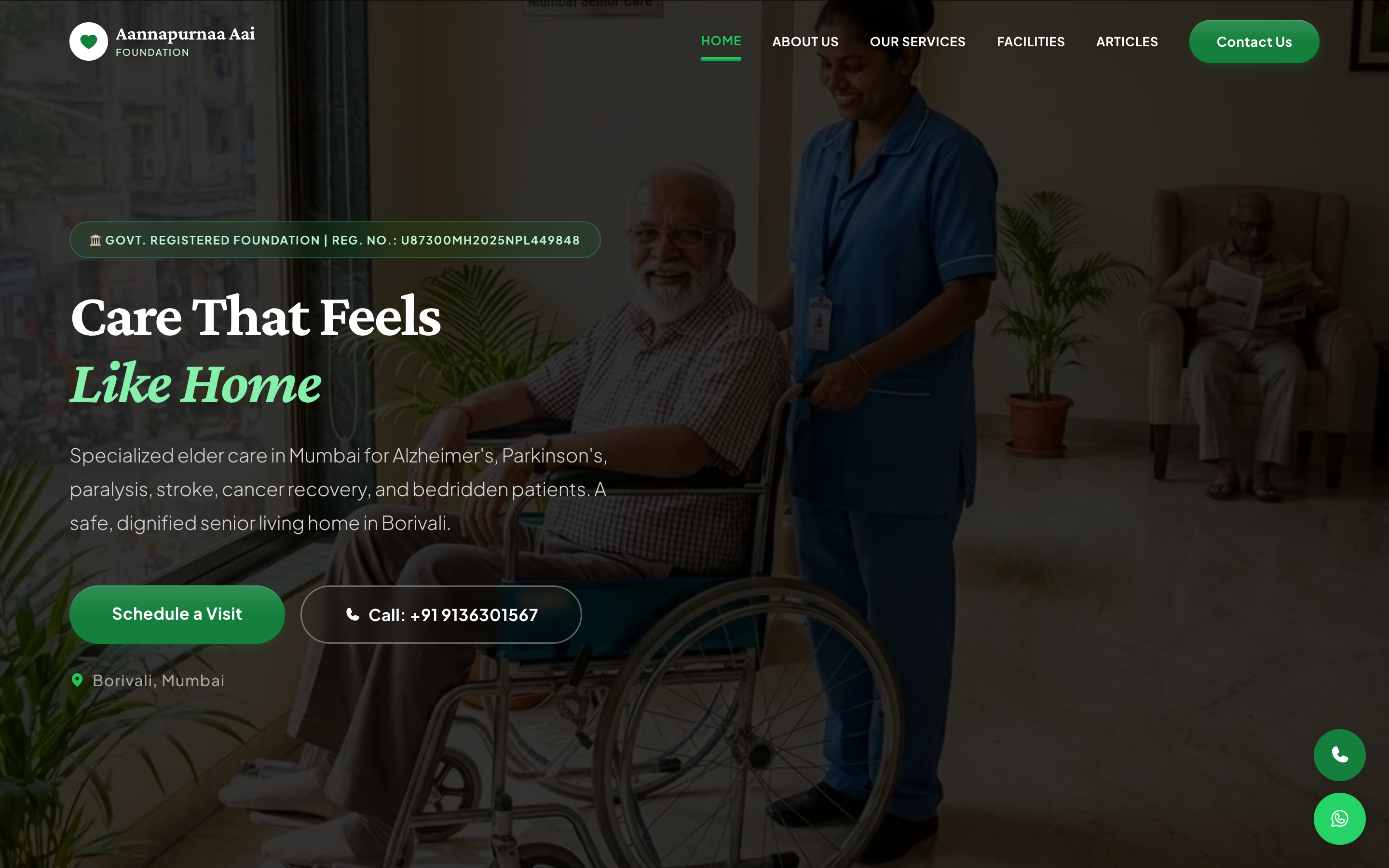
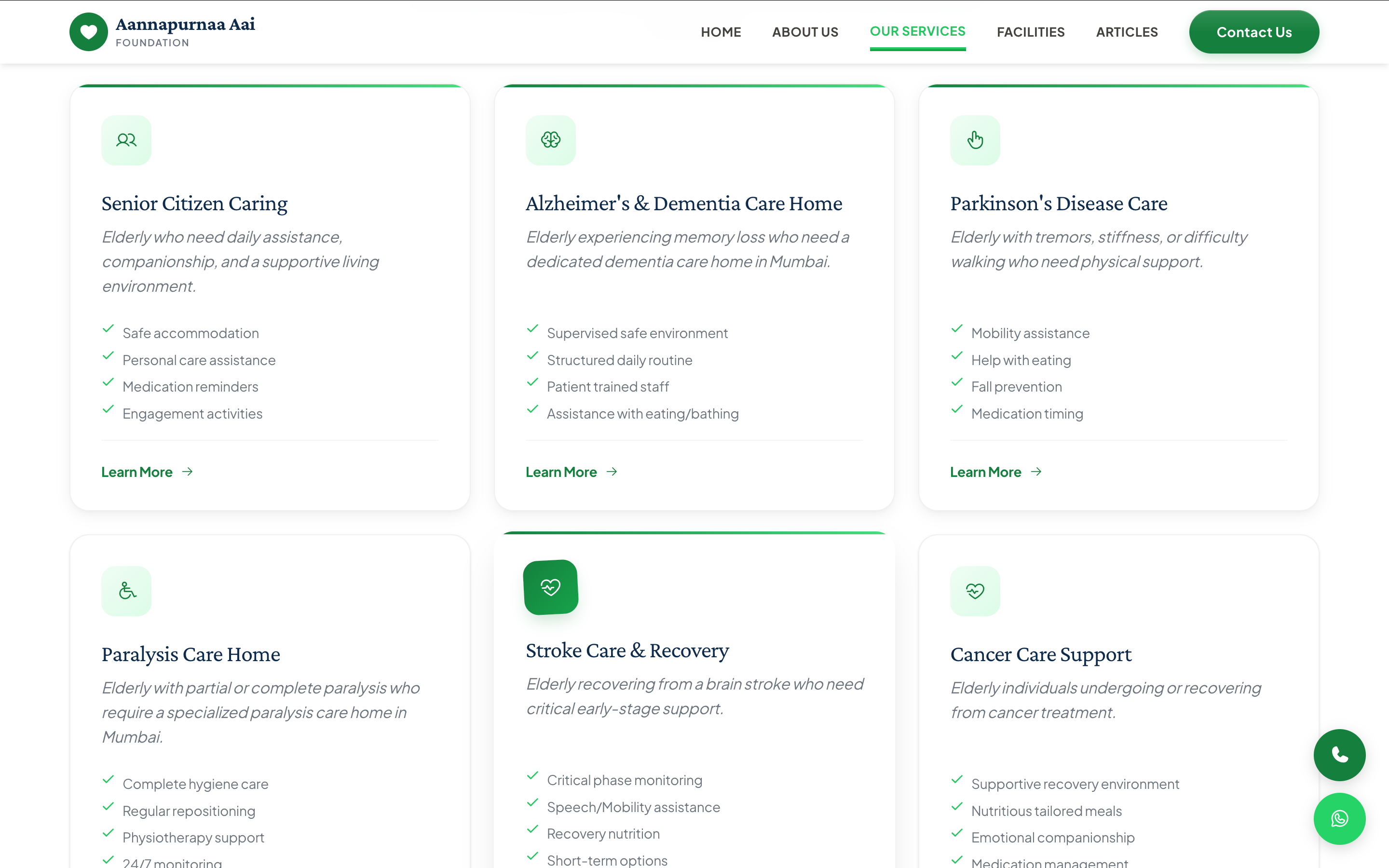
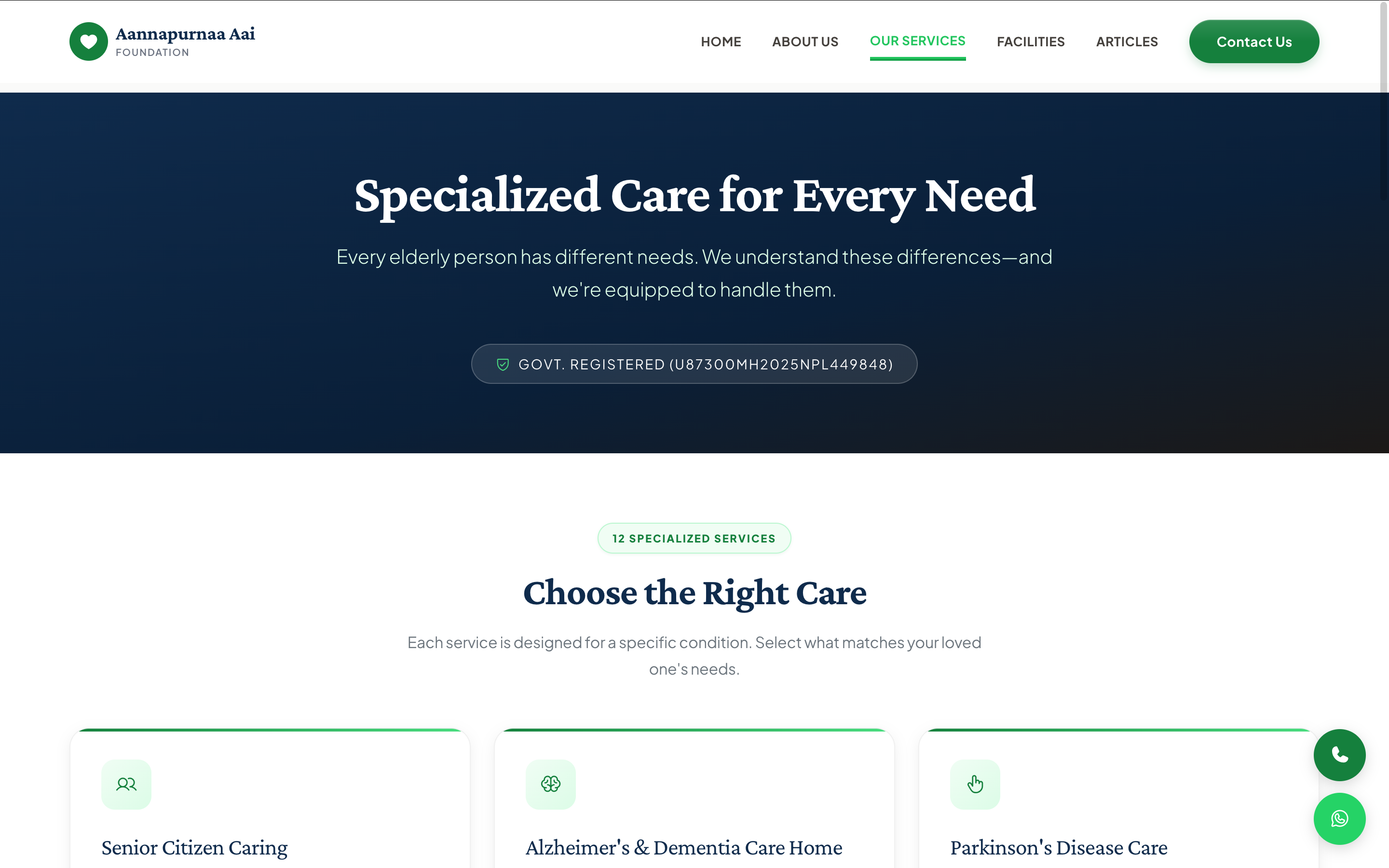
Services — 12 care types, each a pillar SEO page.
Senior Citizen, Alzheimer's & Dementia, Paralytic & Stroke, Cancer Care, Post-Surgery Recovery, NRI Elder Care, and six more. Each card maps to a pillar page from an identical template — same heading hierarchy, checklist density, and CTA placement, enforced by a Claude Code skill and repeatable across all 12.
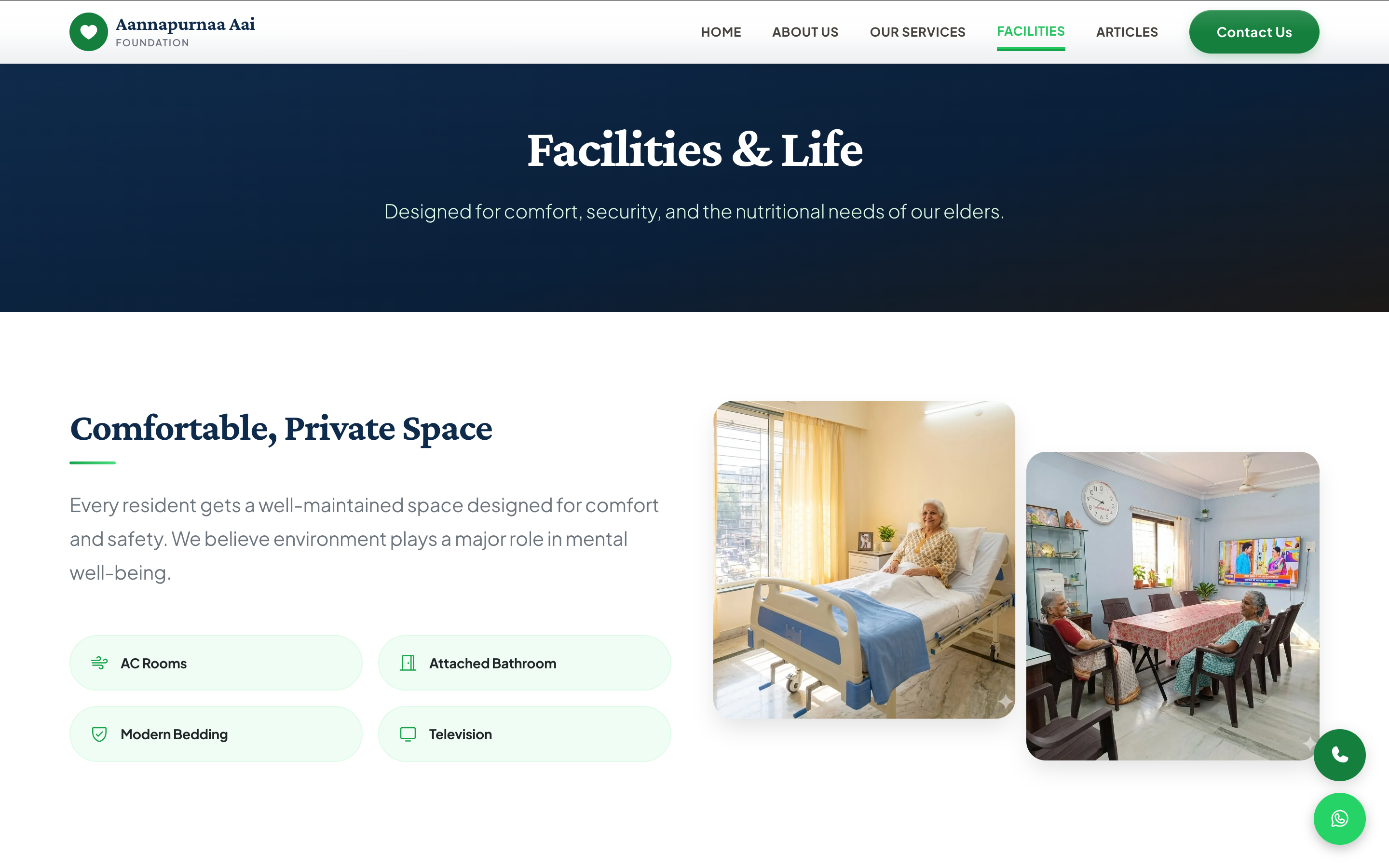
Daily routine — the question adult children actually ask.
The most-asked question is “what does a day look like?” The schedule answers it before they ask — morning tea through night rest — with a footnote acknowledging medical adjustments. Honesty over polish.
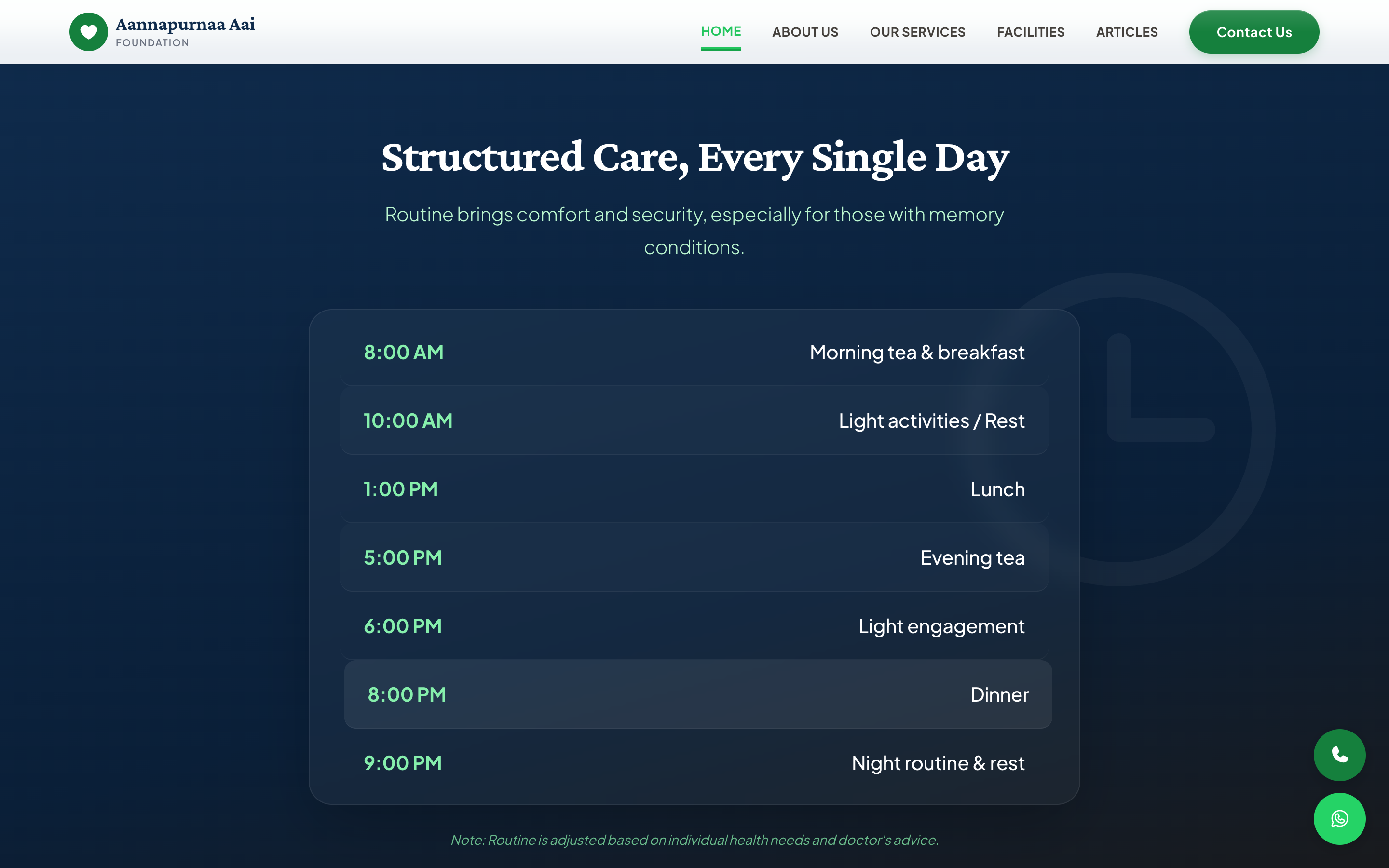
Our Story — trust is built by people, not logos.
Founders Sammeer and Ssunita Nawathe on the page with names, faces, and why they started. “Aannapurnaa” is the Goddess of nourishment; “Aai” means mother in Marathi. Trust on an emotional decision is built by people, not logos.
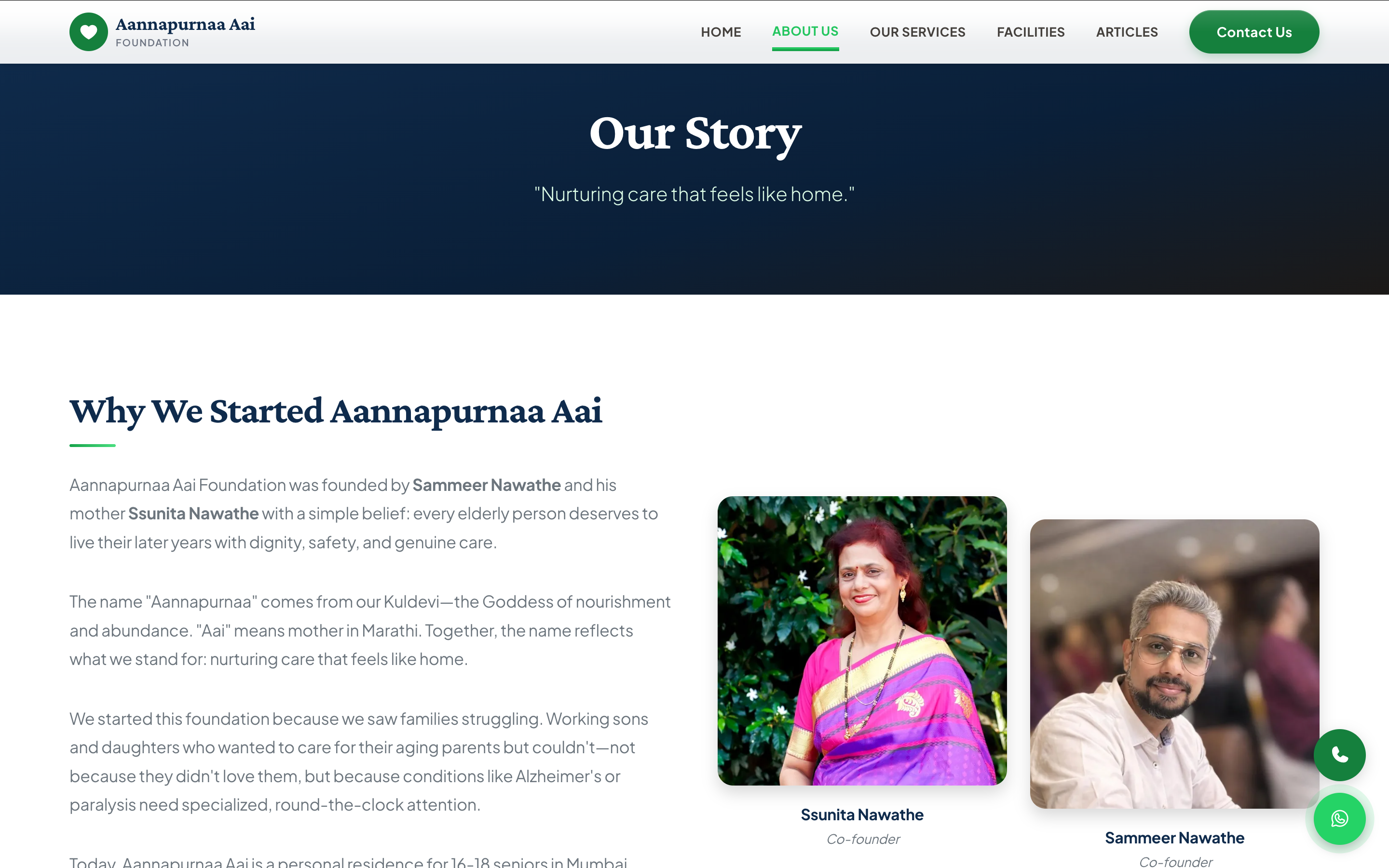
Facilities — the room a parent will sleep in.
Shown, not described. Adult children compare physical environment first, copy second.
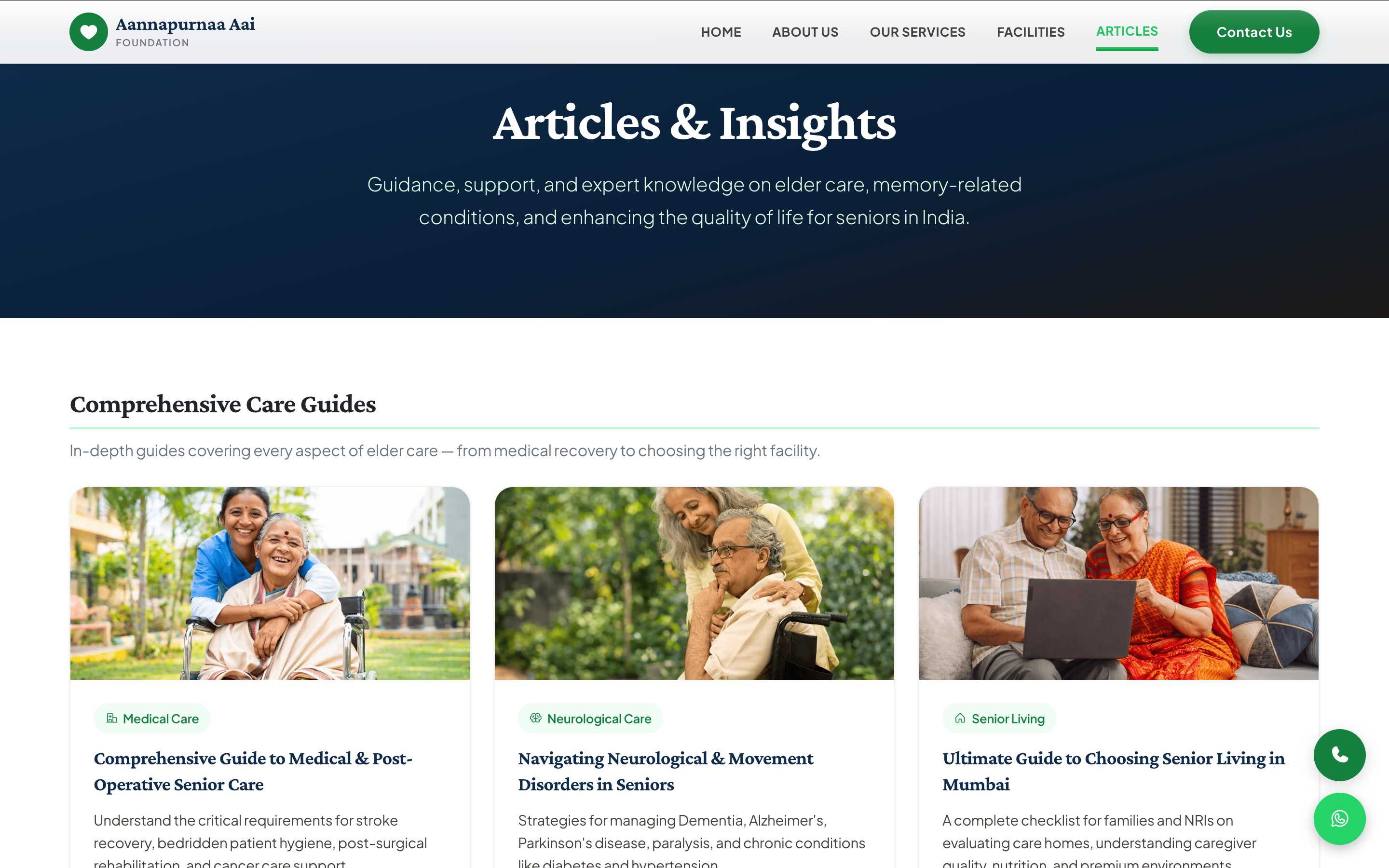
Articles — the visible surface of the pillar-cluster system.
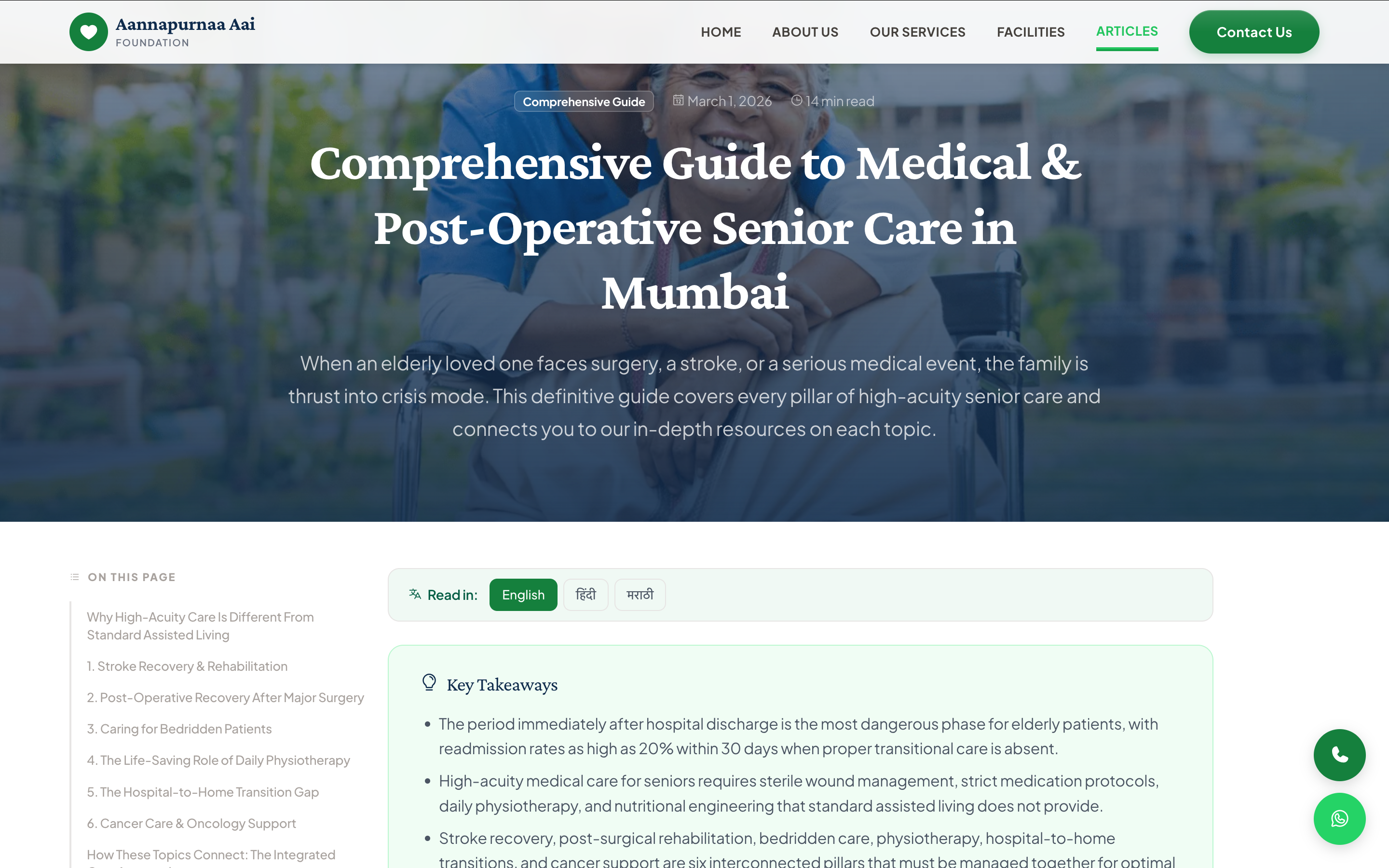
30+ in-depth guides indexed by category, each with an English / Hindi / Marathi toggle, a Key Takeaways block, on-this-page nav, and dense internal linking back to the pillar service page it supports.
Three days of thinking. Six hours of building.
Speed is a byproduct of clarity. The 6-hour build was only possible because three days of thinking had already answered every question Claude would otherwise have resolved mid-execution. Of 78 hours total, 72 were thinking and 6 were building.
Blog content was research-first: for every topic, Claude queried DataForSEO for ranking keywords, search volume, and competitor content, then wrote articles built to rank from the first word — not blogs tagged with keywords after writing. Each of the 12 services became a pillar with 2–3 cluster articles linking back to it and across to related clusters.
The content pipeline
DataForSEO keywords → Claude reads skills → Research + write to rank → Pillar + 2–3 clusters → Internal links → Deploy
Pillar
Alzheimer's & Dementia
Pillar
Paralytic & Stroke
Pillar
Cancer Care
Pillar
Post-Surgery Recovery
Pillar
NRI Elder Care
Pillar
Senior Citizen Care
12 PILLARS · 30+ CLUSTER ARTICLES · ONE INTERCONNECTED RANKING SYSTEM
Eight decisions that did the disproportionate work:
Decision
What it reveals about how Janam thinks
Bootstrap + static HTML over Next.js.
Right tool for the actual problem, not the most impressive one. A static informational site for a mobile-first, non-technical maintainer — framework overhead would have been engineering for its own sake.
Vibrant, warm visual direction.
Translates a strategic insight ('home, not institution') into a visual language. Trust on an emotional decision needs warmth, not clinical precision.
Photography brief given to the founder.
Trust requires authenticity. Directed the client to produce real moments, not accept whatever stock was on hand.
18-resident cap as the hero message.
Turns a perceived limitation into the moat. Scale isn't what these families want.
4 Claude Code skills written before development.
Encoded design judgment into project-scoped SKILL.md files Claude reads before every task. The quality gate, not typing speed, is what made 45+ pages possible in 6 hours.
DataForSEO in the content workflow.
Research-first content. Blogs designed to rank from the first word, not tagged after writing.
Pillar + cluster blog architecture.
Builds topical authority systematically. 30+ articles operating as one ranking system — not a blog, an architecture.
Hour-2 quality gate before production.
Caught 3 failure patterns in 2 sample pages, then patched the skills before the factory shipped 45+. Build the gate before opening the factory.
The skills are the deliverable.I wrote four SKILL.md files before any production code — design-system, singleton-pages, service-detail-pages, and blog-pages. Each exists because I identified a failure pattern Claude would hit at scale and hardcoded the fix. They're quality-control systems, not shortcuts.
The Hour-2 gate.At Hour 1, I had Claude generate two throwaway pages from the skills as written. At Hour 2, I reviewed them line by line. Three failure patterns appeared — tone drift, shallow research (drafting without forcing a DataForSEO lookup), and layout drift — and each was a gap in the skills, not in Claude. Every fix went back into the relevant skill before any production page was generated. Consistency after the fixes was ~95% across all 45+ pages, with no per-page review cycle. The gate isn't a code review; it's a skill review.
The system is doing the work it was designed to do.
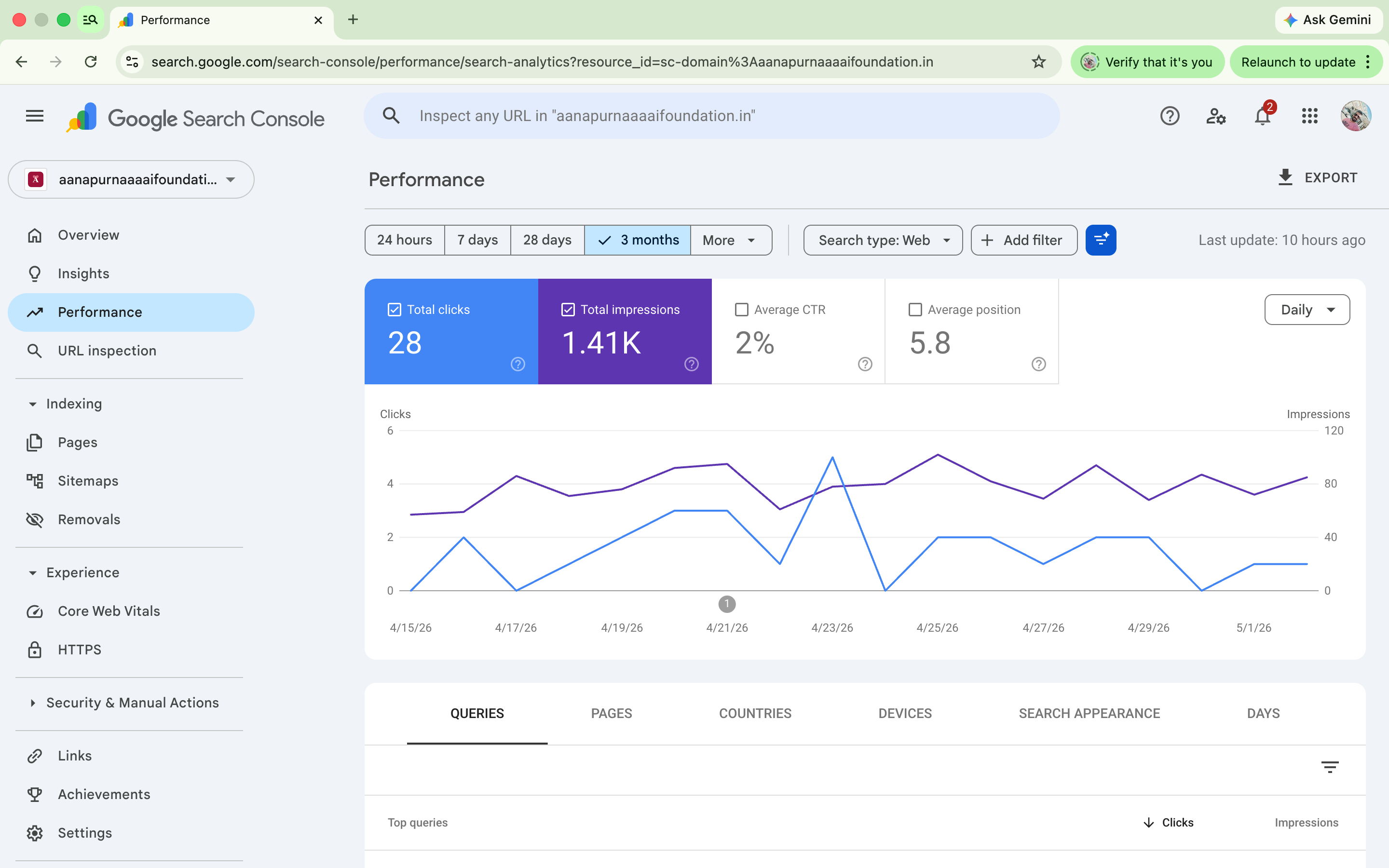
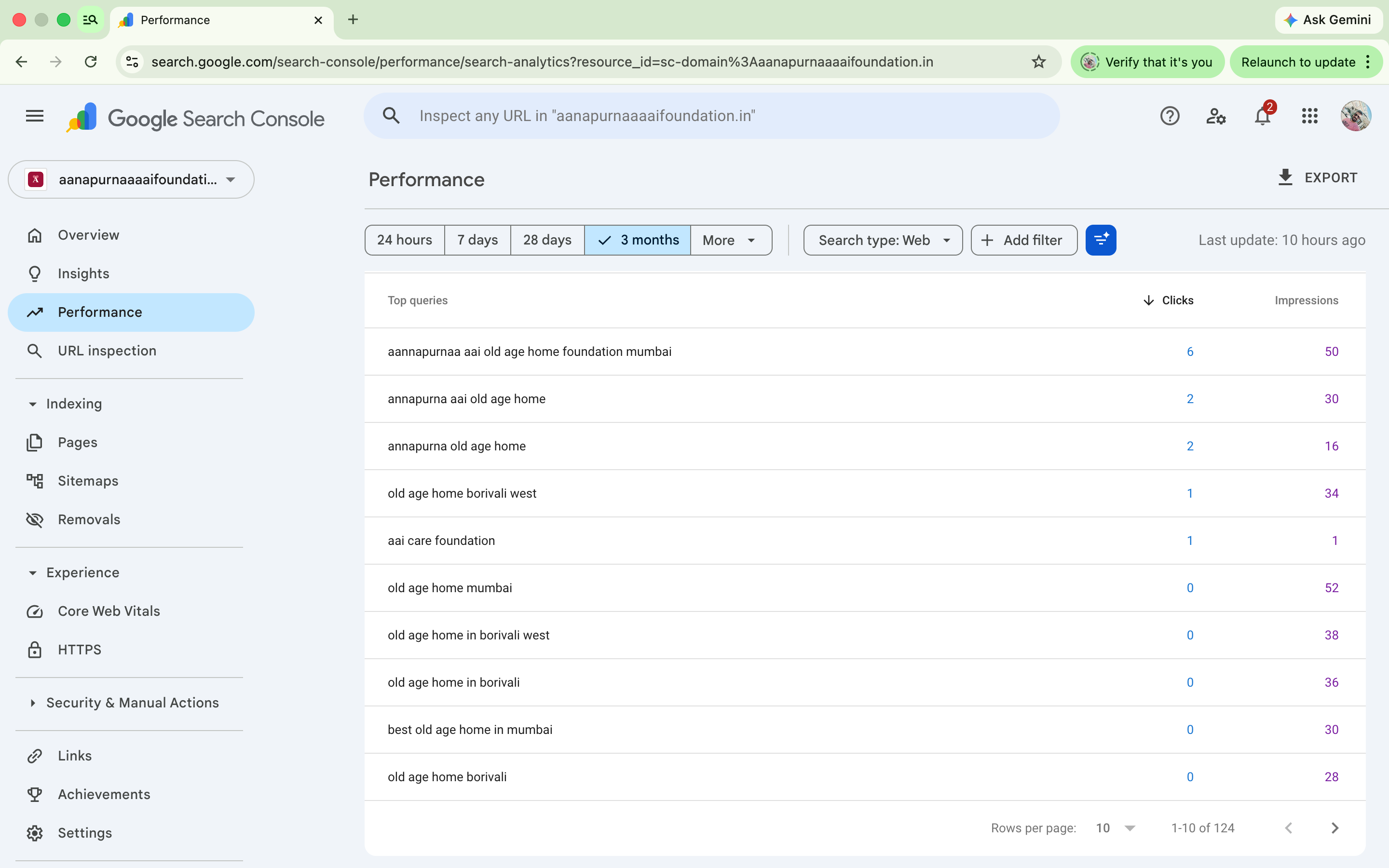
Three months of Search Console from a brand-new domain: 28 clicks, 1.41K impressions, average position 5.8 — page 1 for brand terms and several local-intent terms, the compounding curve a pillar-cluster build is designed to produce. 124 unique ranking queries, brand plus generic intent (“old-age home in Borivali West,” “best old-age home in Mumbai”) — the cluster strategy capturing both.
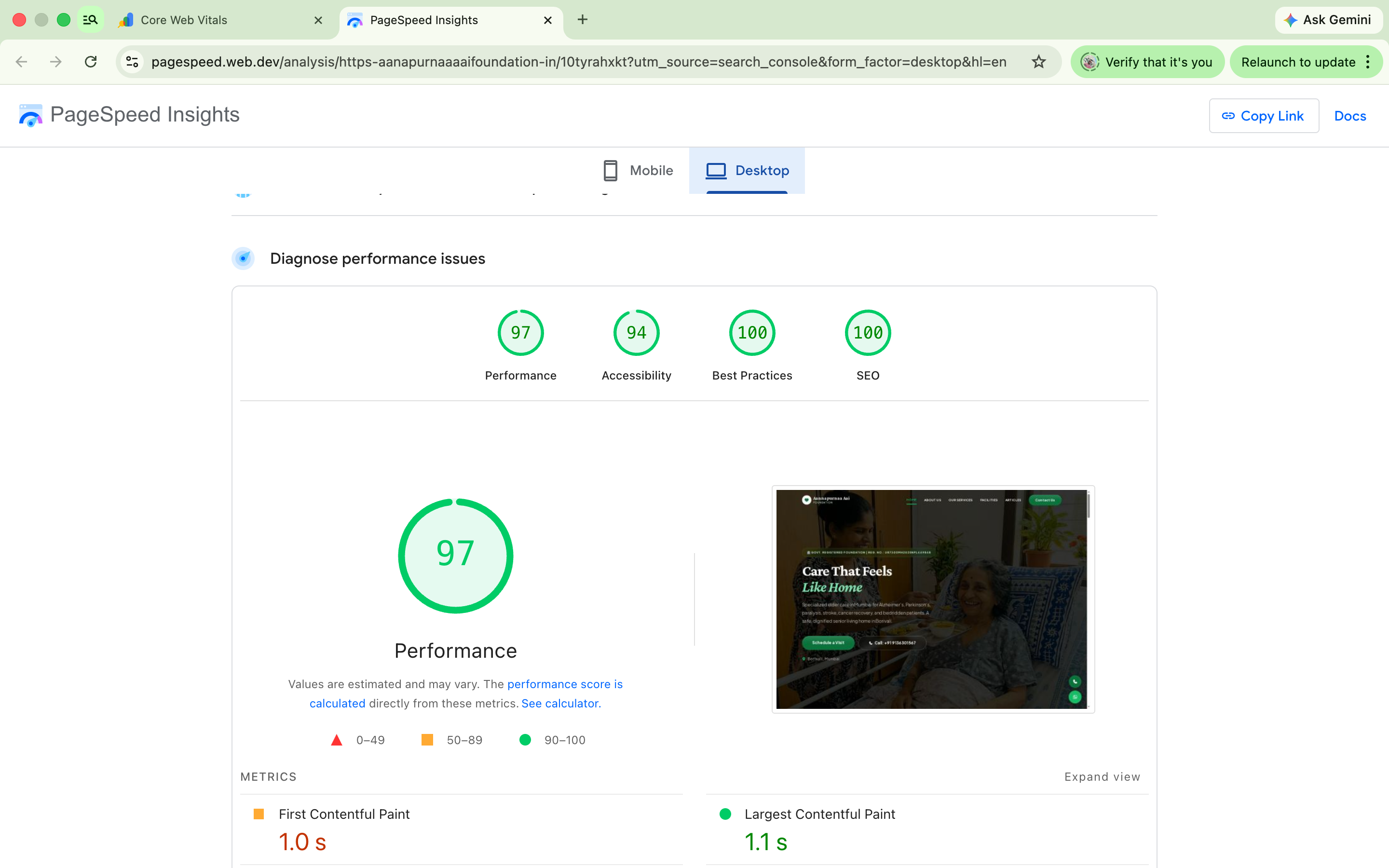
97 / 94 / 100 / 100 with LCP 1.1s on a mobile-first audience. Engineering quality matches design quality — Bootstrap + static HTML wasn't the lazy choice, it was the right one.
What this taught me about AI-assisted development.The mistake most professionals make is treating Claude Code as a faster typist. It isn't — it's a junior engineer that executes literally whatever it's asked, and at scale that produces inconsistent output. The skills are how you stop being a prompter and start being an architect: write the skills first, run an Hour-2 gate to find the gaps, patch the skills, then let the agent ship at scale.
Three days of thinking before six hours of building is how you produce quality at speed. Pro bono work, held to commercial standard, makes a portfolio piece just as strong — the client's budget doesn't determine the quality of the thinking.
Two honest notes for next time:analytics should have been wired before launch, not after — the result is confirmed directionally (the founder says families are calling) but I can't quantify it as precisely as I'd like; and a lightweight CMS (even a Notion-to-HTML pipeline) would let the founder make basic updates without me — the current setup works because I'm available, which is a dependency, not a solution.